


The Kingdom of Bhutan

Updated: May 11

The Kingdom of Bhutan, or Druk Yul, Land of the Thunder Dragon,is a democratic constitutional monarchy. It nestles in the Himalayas.
I have always wanted to experience this mysterious kingdom and made plans to visit it last November, rearranging tours and flights,which the unexpected Iran War thwarted. My flight through Abu Dhabi was canceled five days before my departure, so I scrambled to book another flight bypassing the Middle East on my way to Kathmandu. A huge snag occurred when my flight back from Bhutan was also canceled; I ended up flying to Bhutan a day early. It turned out to be fine, as I planned to attend the Tshechu Spring Festival in Paro.
It was quite an unpleasant month of March, filled with anxiety and uncertainty, since my journey had many connections, and all of which had to be aligned.
Staying overnight in Kathmandu, I finally caught my flight to Paro. Mt. Everest showed its face in all its glory. Niwash, my guide, greeted me, wearing his national Gho, and so did Chencho, the driver; they looked very distinctive.


Paro sits at over 7000 ft, surrounded by the Himalayan mountains, transferring its majesty and peace to me. We immediately drove to Paro Dzong, also called the Rinpung Dzong — a 17th-century Buddhist monastery and fortress— to attend the festival, which had been going on for a few days. Hundreds of locals, men dressed in Gho and women in Kira, and visitors lined the lawns, the slopes, picnicking. We were able to move to the monastery square and watch the dances with elaborate costumes and masks. I was enthralled by the dancers and how Bhutan has cherished its culture and customs.


In the afternoon, we visited the National Museum, which sits atop the hill with a great view of the valley.
We rose early the next day to hike up Taktsang Monastery, or Tiger’s Nest, perched over 10,000 ft above sea level, almost 3000 ft above the Paro valley. I felt short of breath climbing the stairs at the hotel in Paro. I had no time to acclimate to the high altitude.
The fog hid the view of the mountains. For those who chose to ride horses up the mountain, many of them gathered at the bottom. The trail takes roughly 1.5 to 2 hours going uphill. Halfway up was the prayer wheel, and then the tea house, which we decided not to stop. It was a long, steep climb until we finally had a view of the monastery, and then another 800 steep steps before reaching it. There were nine temples in the monastery, and we visited almost all of them.

In the afternoon, we wandered around the town center and the marketplace, mingling with the locals.
We got up at 5 am to see the 20 x 20-meter Thongdrel thangka, a gigantic scroll that escaped the 1903 fire; most of the relics and statues were destroyed.

The scroll took place from 3 to 4 am. By the time we arrived, it was fully unfurled, and hundreds of Bhutanese were already there, and many more lined up, believing that paying homage to it brings spiritual merit.
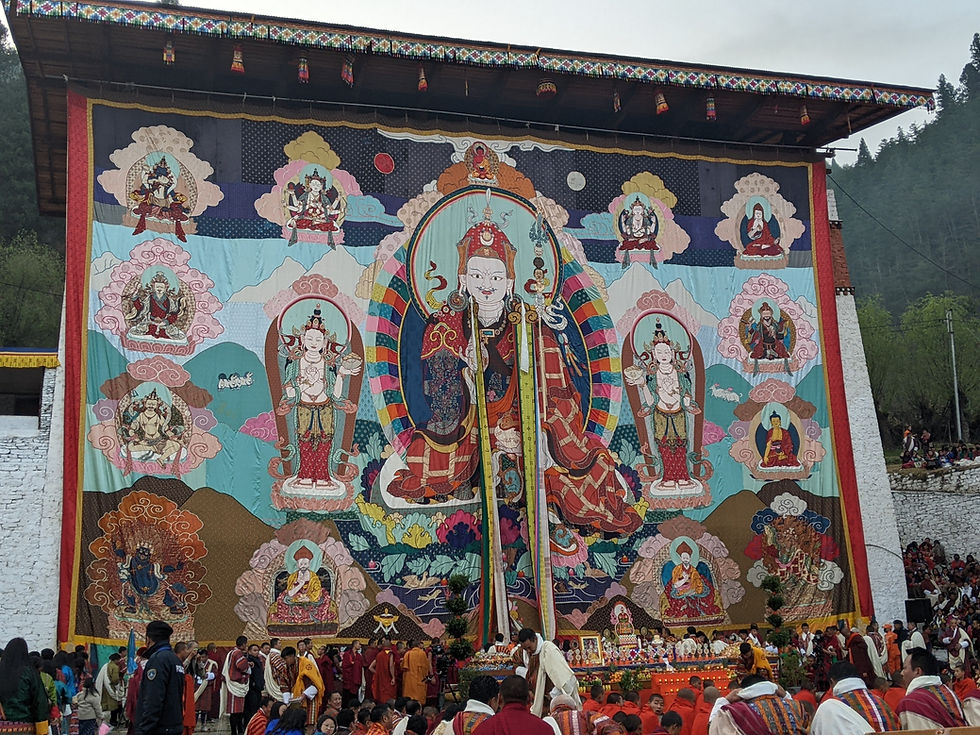
It was a sight to behold. Padmasambhava, meaning born from a lotus, also known as Guru Rinpoche, was set in the center of the tapestry surrounded by it eight manifestations. He brought Buddhism from Tibet to Bhutan, and legend had it that he rode on a tiger to this region. In the morning, the King of Bhutan graced us with his presence. Dances were performed for the rest of the day. Niwash took me to visit the temple in the Dzong in the late afternoon.

The next morning, we drove for about 4 hours to Phobjikha, passing the Dochula Pass at 10,000 ft, visiting the Druk Wangyal Chortens with their 108 chortens commemorating the military operation in 2003 by the Royal Bhutan army against Indian separatists. Fog prevented the 360-degree viewing of the Himalayas.

At Phobjikha Valley, we visited the black-necked crane sanctuary where Karma and Pema, the two rescued cranes, reside.

I had a hot-stone bath. In the morning, we hiked a 2.5 km nature trail to see the Gangtey Goempa, a 17th-century monastery with a commanding view of the valley.


In the fall, hundreds of cranes migrate to this valley from the Tibetan plateau when the Crane Festival takes place on November 12th in the valley and the monastery, a day after the King’s birthday.
The next day, we drove to Punakha to visit the Wangdue Dzong, a 17th-century fortress built where two rivers meet. It is my favorite Dzong, and I can only imagine how beautiful it is in May when the purple jacaranda flowers bloom. Then a hike to the longest suspension bridge across the river with views of the villages. We stayed overnight at Punakha in a quiet hotel overlooking a river.


In the morning, we headed to Yabesa village and hiked through rice fields, then up to Khamsum Yueley Namgyal Choreten, a shrine on a hill with a panoramic view of the valley. We wound our way back to Dochula Pass to Thimphu; it was still cloudy, and the mountains were not in view.


Thimphu is the capital of Bhutan. In the morning, the Great Buddha Dordenma, a massive 169-foot gilded bronze statue of Shakyamuni Buddha, sits atop a hill in the Kuenselphodrang Nature Park.

In it, there were 125,000 smaller gilded Buddha statues. On our way down, we viewed the Tashichho Dzong, from the mountain slope, a fortress-palace now housing the government.


Then off to the Royal Takin Preserve to see the takin, Bhutan's national animal, some Sambar, barking deer, and a couple of very colorful Himalayan monals. We visited the local folk museum, watching artisans weave, weld, and paint mandalas. I tried my hand at archery.

On our way back to Paro, we visited one of the oldest iron bridges, no longer in use.

Niwash and Chencho saw me off early in the morning, catching my flight to
Kathmandu, Nepal. I wished I had more time in the countryside, in the valley surrounded by mountains. It seemed like I just had a taste of it; there are many more areas to explore. Besides being impressed by the pristine nature, I am also enamored bythe Bhutanese, who fully embrace their traditional clothes.
The nice weather graced us with another spectacular view of Mt. Everest.
At Kathmandu, where I spent a night, I visited the Pashupatinath Temple, a UNESCO WORLD Heritage site and one of the most sacred Hindu temples dedicated to Shiva. The guide told me it is their little Varanasi, many cremations took place, and the ashes were pushed into the river, which will eventually join the River Ganges in India.

This reminds me that our life on this earth is ephemeral. We have to make full use of it.
Bhutan Travel Adventures and Personal Reflections on Travel
My fourth book can be preordered: Finding Independence in America: An International Student's Journey from Malaysia to Medical School
Also at Barnes & Noble, Amazon, Walmart
Other books: The Girl Who Taught Herself to Fly paperback, ebooks and audiobooks


Excellent photos of Bhutan and Nepal! Brings me memories of past Himalayan treks to Langtang Valley and Khumbu region (Everest via Namche Bazaar, Mt Ama Dablam, Dud Khoze River) NEPAL when the King and Queen of Nepal reigned in May, 1980. Our party with Mr and Mrs Robert McNamara was hosted by the Lama Rimpoche when we camped on the grounds of the Thangboche Monastery (12,800 ft). We climbed to > 17000 ft. Ohm mane padmi ohm, such beautiful mountains and terrain in the clouds. Aside I visited leprosy colonies in Pokhara NEPAL and Chiang Mai Thailand. Thank you for sharing.